
Doctor's Note — Issue 35 — Slop and Discernment
A Slopslided Marketplace / Discernment and AI / Hatch Ateliers / Coaching Reflections & Power of Ten / The Linkhole
Welcome to the latest Doctor’s Note. This one talks about AI, but before you unsubscribe, don’t worry, I don’t plan to make a habit of it.
I am pretty snarky about AI bros and boosters online, which might give you the impression I’m entirely negative about it. But I’ve actually been thinking about this stuff for a long time. I wrote a piece for The Age way back in 2002 about mobile spam (slop) and AI agents and a long essay about design in the age of AI back in 2019 among others. I can’t believe 2002 is 24 years ago, but here we are.
Here are two long thoughts about AI, culture and design.
Subscribe now
A slopsided marketplace

Recently, I’ve found myself switching off as soon as I get a whiff of an LLM in a message or post. These days, it’s difficult to know for sure, because people have started to copy the style in their own posts.
In this way I think of AI slop as a double polluter. It pollutes the environment through excessive resource consumption and it pollutes the cultural landscape with slop. LinkedIn is the prime example of an increasingly enslopified commons.
The Anthropic adverts skewering ChatGPT did a wonderful job of demonstrating the icky feeling of being on the receiving end of AI slop output.
Plenty of people, like Microsoft CEO, Satya Nadella, contest that AI makes them more productive by summarising emails and meetings. They also use AI to help them write emails and LinkedIn posts. But I know of nobody who says, "I really enjoy reading AI-written content.”
A similar lopsided marketplace problem also plagued the sharing economy in the early 2000s. Most people like the idea of borrowing, very few like to share. Supply can’t match demand and they fail. I hope so.
When this contaminates services it is really problematic. A recent blunder from ME Bank in Australia sent homeowners a note telling them the Reserve Bank of Australia was putting up its interest rates and that they were “pleased to announce that we are passing on this rate increase in full on your variable home loan(s).“
Each one of these feels like a tiny act of thoughtlessness, of not engaging with the human, of not caring. The only way to be personal is to be personal. It’s something that we humans as social creatures are finely attuned to.
Seth Godin made an insightful point recently that helped it all click into place for me. It’s not the technology. It’s the intent:
“It’s not slop because it was created by an AI. It’s slop because it’s slop.”
Discernment, Design and AI

I think both physical and digital product design has become rather boring over the past decade. In digital, designs and designing became systematised for fast delivery at scale and the The Age of Average kicked in hard.
A lot of the time that’s fine. Mediocrity is better than awful, after all, and not everything needs to be a bespoke suit. Sometimes an H&M t-shirt is all you need. Most public service touchpoints are better than they were 10 years ago, which is a Good Thing. By contrast, many commercial products and services fell into feature enshitification and have become worse. This is a Bad Thing.
But it wasn’t until I saw Iain Tait’s ridiculous little vibe-coded site, Fit Drop, that I realised I had been missing the playful exploration of interactive media for a while. Some folks are convinced all problems had been solved. I maintain that digital interactive media is still very young and immature compared to other media forms. There’s a lot yet to explore.
I came of age, professionally, during the early 90s era of Macromind Director, Flash, HTML and CSS. The breakthrough with those tools was that non-developers could make interactive things and easily put them out there in the world. That might sound trivial, but helping to define a new medium and routing around traditional publishing gatekeepers was a big deal. From it emerged the Internet and interactive paradigms we know today.
When we made Antirom, we were experimenting the entire time, passing our little code “engines” (prototypes) around to each other to iterate changes in code or try out different images and audio. Our code was rubbish and full of bugs and we knew it, but our different, non-programmer mindset led to us discovering many playful and essential affordances of interactivity. Quite a few of these are now part of the interfaces we use every day.
Then it all went away.
The lost art of noodling
The demise of Flash (never my favourite) coincided with the rise of AJAX and greater technical complexity for creating websites and, later, apps. Instead of noodling around in Lingo, Actionscript, or simply opening a text file and saving it as HTML or CSS, we had to start installing JS frameworks like React and Node. That pushed it into developer territory and away from the creative crowd. We’ve largely been without any non-developer tools for playful noodling ever since. Clickable Figma mock-ups simply aren’t the same thing.
AI tools like Claude Code and Co. are enabling this once again. I’ve been reading and hearing many a digital design veteran rediscovering the joy of noodling and making interactive things.
That said, it seems likely that the AI bubble will burst before the end of the year (I have a small bet with Peter Merholz on this). That will radically change the situation. Silly little experiments might just be even more unconscionable than they are now, given the horrific resource consumption. After the crash, what remains is what will be interesting, not what is hyping now.
A litmus test I use is to ask whether you’d be willing to pay ten times the current cost to do what you’re doing with AI. Many times the answer is no, which should worry start-ups dependent on other people’s APIs and models.
To counter my inner AI curmudgeon and bathe in a lake of hypocrisy, I felt it important to get my hands dirty. Well, get Claude’s hands dirty. I vibe-coded a bespoke expenses scanning app in Cursor (it was rather rubbish — I could have done the data entry myself in the time it took) and Claude Coded a new Hugo theme for my website.
I wouldn’t say the latter was “vibe coded.” I was very clear about what I wanted, which was basically what I had before, just slightly tweaked. I’ve tended to my website for 30 years, so I still know how it is built, which helped me guide Claude and still understand what was under the hood. The Claude experience was kind of enjoyable, though it also left me feeling a rather empty, like I’d just wolfed down an entire pack of Jaffa Cakes.
Demos and discernment
There are two things that really stood out that I feel are being overlooked in all the hype and doom cycles.
The first is not that PMs will replace designers and engineers, or that engineers don’t need designers, or whatever flavour of that equation you believe in. Naturally, everybody thinks that they don’t need the others. I doubt this will end up being the case, but the configuration and weighting of collaboration changes.
What happens is that the craft discipline silos start to break down when everyone can make a demo. This means the Venn diagram of the product trio overlaps much more than before. And this is also a Good Thing, because the more that happens, the more everyone has a shared language of the artefact to have a conversation about. But it’s crucial to remember there are three different mindsets with domain knowledge having that conversation.
I’m deliberately using the word demo that Ken Kocienda uses in his book, Creative Selection: Inside Apple’s Design Process During the Golden Age of Steve Jobs. (Kocienda created the iPhone keyboard and predictive text. The demo of it was built in Macromedia Director by Bas Ording.) Demos and prototypes sit on a continuum, but I consider demos something to help you show a concept to other people in a form that looks and feels like the real thing. Prototypes are things you create to test something you don’t know until you build and test it. There is an overlap, I know, but the intent is an important point of distinction. A demo is an interdisciplinary collaboration boundary object.
AI tools—like the multimedia tools of yesteryear—allow you to make an artefact that looks superficially like the real thing. It may well function just like the real thing and you may even decide to ship it. (like my website). But something that is fully generated doesn’t have the discernment that domain experience brings. In my view, that’s what the conversations about “taste” are really about.
This isn’t a new debate. A good comparison is in music and, decades before that, desktop publishing. A novice can put together a track in GarageBand using Apple’s presets and loops and create something that sounds like a commercial piece of music from a production values standpoint. But it will usually lack that extra something that makes a hit. A great producer can articulate why. A newbie cannot.
Show your working
The second thing that stood out was the importance of articulating design. Many design leader coachees have complained to me over the years that their junior and mid-weights only bring polished Figma work to review sessions and are unable to show their working or articulate the rationale behind their designs. If you’re starting directly with Figma and an existing design system, designing becomes more like creating scenes in Playmobil. It will be fine, but many of the creative decisions have already been made.
One of the interesting things about using skills within Claude is that they are just Markdown text files describing concepts. I decided to try Paul Bakaus’s Impeccable “AI harness” for my website re-design. When you take a look at the skills files, you read an experienced designer unpacking their internal algorithm and articulating design decisions.
Designers who are able to do this are going to be worth their weight on a team, because now the design system’s quality is not just the design and the tokens, it’s how well you can explain what quality is in words. That’s something that takes practice and experience. That is discernment—whether this is the right thing for the right context.
The question is whether junior designers will get the chance to build up this experience and discernment. For design leaders, this means taking a more Socratic approach to your leadership and mentorship of your team. It’s essential for you to unpack your own thinking and explain it and help them do the same. That’s very different from just giving direction.
The age-old lesson here is not to label and identify yourself with the tools (R.I.P Flash designers). It’s never the tool that makes the master. It’s the practice.
The bigger challenge is relational, not technological. As Simon Penny once said, true interdisciplinary collaboration requires deep professional humility.
To get there, we have to stop pronouncing the death of other professions.
Join me at the Hatch Ateliers, Berlin
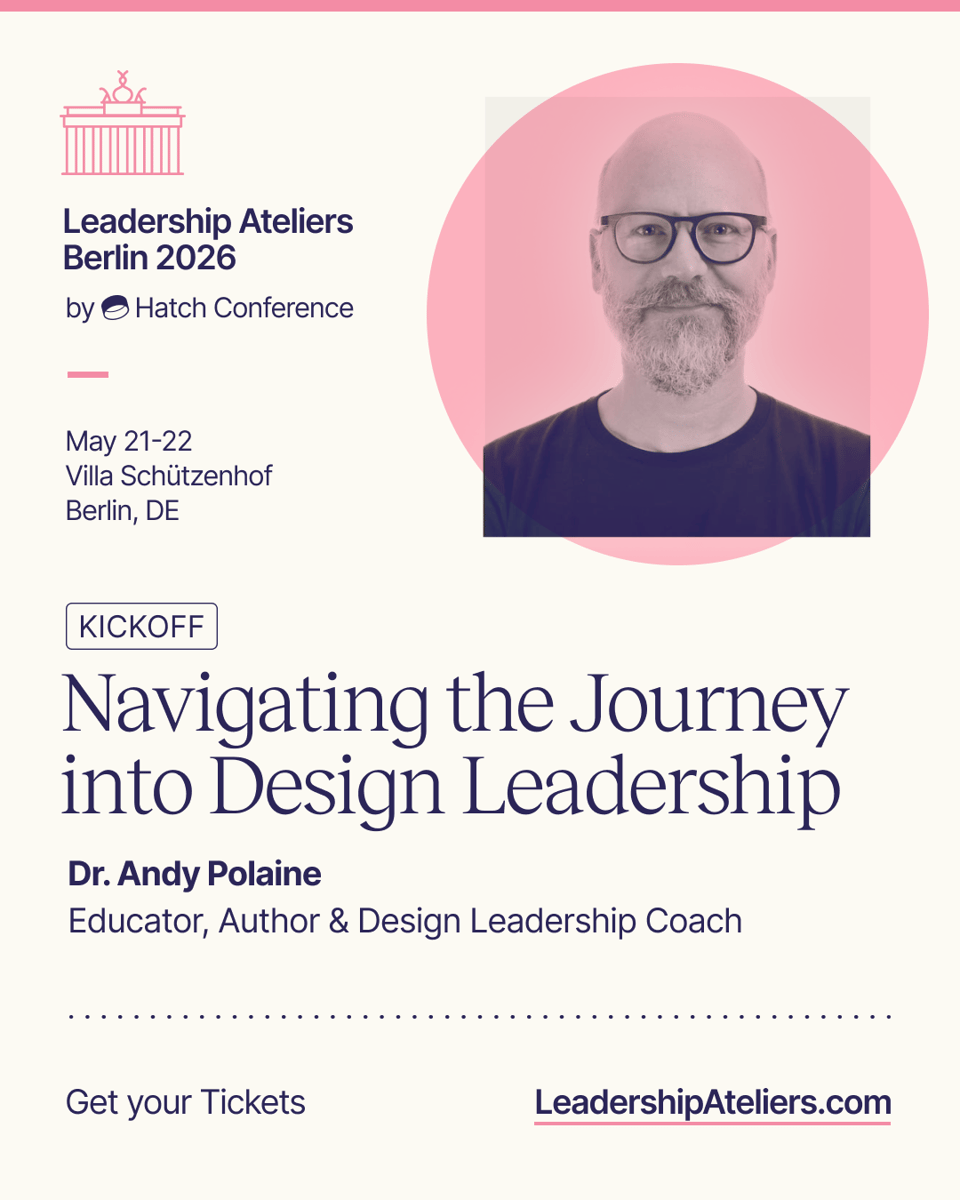
I’ll be doing the kick-off session again at the Hatch Ateliers in Berlin, May 21st-22nd, focused around transitioning into design leadership.
I really loved the Atelier in Lisbon. Damian and his crew really put on lovely, small events (80 people), in amazing venues. For me, it’s a chance to share some of the activities I do in one-to-one coaching with a larger group of people.
Despite living in Germany, I’m not as connected to the German design community as I would like, so I’m really looking forward to meeting folks there. DM me on LinkedIn or reply to this newsletter if you’re going to be there.
Power of Ten & Coaching Reflections
Project closures are as important as kick-offs. Build them into your default settings.
I thoroughly enjoyed my Power of Ten chat with Alan Colville about the importance of leaning into conflict at work and life.
My most recent Power of Ten guest is from a recording I made 10 months ago. Criminal of me, given the pace of AI. Joel Bailey, then product and service director, now COO, at Arwen.ai, talks service design, AI, and social media moderation.
The Linkhole
A report from UTS on the implications of AI and cognitive offloading in education. There’s a connection between the role of teachers and my point about design leaders and AI above.
I used to have a “Guff of the Week” section for consulting nonsense quotes. Now we know workers who fall for ‘corporate bullshit’ may be worse at their jobs, according to this study. Put a pin in that.
Design teams struggle to keep up with fast-paced dev workflows. Lots of insight from Jason Cyr, although I don’t agree with his conclusions. Lots of good conversation in the comments.
The Conversation Trap: why defaulting to chat might be the biggest interaction design mistake of the AI era. This is a long, well-researched, and super important piece by Itamar Medeiros. If you’ve been irritated by the rise of prompt boxes instead of UI in apps, now you know why.
If you’re wondering how and why Big Tech ended up like this, I urge you to read The Californian Ideology by my ex-lecturers Richard Barbrook and Andy Cameron (Andy also co-founded Antirom with us students). This has become an annual reminder from me.
Which also leads to this latest piece, The Texan Ideology by Fred Turner (by way of Cameron Tonkinwise).
A soft-landing manual for the second gilded age by JA Westenberg is a salve to the above. Kind of.
It feels right to finish with this: Now is a good time to shut up about AI.
That’s it for this issue! Thanks for making it this far and for reading, listening and watching.
Until next time,
Andy
❤️

